
The Golden Hour on the Steppe: Lighting Techniques for Flat Landscapes
In landscape and wildlife photography, we are often taught to seek "drama." We look for jagged peaks, crashing waves, or deep canyons to provide geometric interest and scale. But there is a landscape that is far more unforgiving, yet potentially more rewarding for the master of light: The Flatland.
The Great Hungarian Plain—the Puszta—is a landscape of minimalism. It is an infinite horizon line where the earth meets the sky with zero interruption. For the novice, it is daunting. There are no mountains to hide behind, no valleys to create shadow depth. There is nowhere to hide bad lighting.
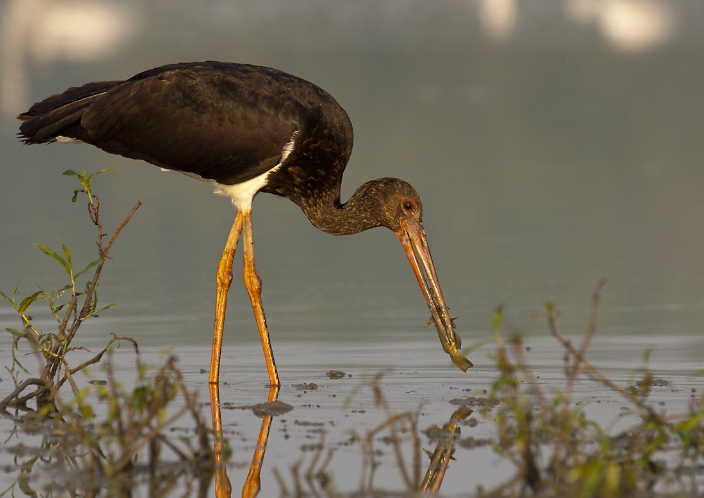
But for the technical photographer, this flatness is a superpower. It means the light is unobstructed. From the moment the sun cracks the horizon to the moment it vanishes, you have direct, manipulatable access to the photons.
However, harnessing this light requires more than just a camera. It requires Elevation Control and Orientation. You cannot shoot the steppe from a standing position at noon; the images will look two-dimensional. You need to be embedded in the landscape.
This is where Ecotours has established itself as the premier logistical partner for photographers in Eastern Europe. Their network of hides in the Hortobágy and Kiskunság National Parks is not placed randomly. They are positioned with the precision of a sundial, designed specifically to exploit the low-angle light of the "Golden Hour."
Here is a technical deep dive into how to master the light of the steppe, using the infrastructure of Ecotours as your studio.
Part I: The Physics of the "Big Sky"
Why is the light in Hungary different? It comes down to Atmospheric Diffusion.
The Puszta is a basin. In summer and autumn, the heat creates a layer of dust and moisture that hangs just above the ground. When the sun is low (0 to 10 degrees above the horizon), the light travels through a thicker layer of this atmosphere compared to a mountain environment.
The Photographic Result:
-
Natural Softbox: The harsh blue wavelengths are scattered, leaving only the red and gold spectrums. The light acts like a giant softbox, wrapping around the subject rather than hitting it directly.
-
The "Glow": Because the horizon is flat, the sun remains visible for longer during the transition times. You get an extended Golden Hour (sometimes lasting 45-60 minutes) compared to mountainous regions where the sun drops behind a peak and the light dies instantly.
The Challenge: To capture this, you must be facing the right way. A public viewing tower usually faces one direction. If the sun is behind you, the image is flat. Ecotours hides are built in pairs or clusters, offering 360-degree coverage of specific roosting sites, allowing you to choose "Backlight" or "Frontlight" depending on the atmospheric conditions.
Part II: The Low Angle – Breaking the Horizon
The biggest mistake photographers make on flat terrain is shooting from eye level (1.7 meters).
-
The Physics: At standing height, the ground dominates the frame. The background is the grass immediately behind the subject (5-10 meters away). This creates a busy, textured background that competes with the subject.
-
The Fix: You must get the lens below the vegetation line.
Ecotours Infrastructure: This is the primary selling point of the Ecotours "Sunken Hides." These structures are buried into the earth. The lens shelf sits flush with the ground level (or water level).
-
The Result: When you shoot a Great Bustard or a Stone Curlew from ground level, the background is no longer the grass 10 meters away; it is the horizon line 5 kilometers away.
-
Bokeh Compression: Because the background is so distant, even an f/6.3 aperture renders it as a creamy, uniform wash of color. The subject pops in 3D relief. The horizon line drops to the bottom third of the frame, filling the rest with that dramatic, colorful sky.
Part III: Technique 1 – The Rim-Lit Silhouette
The flat horizon allows for one of the most dramatic shots in wildlife photography: the total silhouette against the sun. In the Hortobágy, this is most famous with the Common Crane (Grus grus) migration.
The Setup: Ecotours guides position you in a hide facing West at sunset. The sun is a giant orange ball touching the earth. As the cranes fly in to roost, they cross directly in front of the solar disk.
The Settings:
-
Metering: Do not use Matrix/Evaluative metering. It will try to expose the dark bird, blowing out the sun to white. Use Spot Metering on the brightest part of the sky (just next to the sun), or manually underexpose by -2 or -3 EV.
-
Focus: Lock focus on the horizon line or the roosting birds.
-
The Goal: You want pure blacks and rich oranges.
-
The "Rim" Bonus: If the bird is close enough (e.g., a Red Deer stag on a ridge), the sun will catch the fuzz on the antlers or the feathers on the neck, creating a glowing outline (Rim Light) that defines the shape even in total shadow.
Part IV: Technique 2 – Front-Lit "Golden Wash"
Conversely, shooting with the sun directly behind you (facing East at sunset or West at dawn) on the steppe creates a specific look called "The Golden Wash."
Because there are no shadows cast by mountains, the light hits the subject horizontally. The Subject: This is perfect for the Red-footed Falcon or European Roller. These birds have structural colors (iridescence) that require direct light to pop.
-
Ecotours Orientation: The Tower Hides are oriented to catch this low, horizontal light.
-
The Effect: The warm light intensifies the rusty reds of the falcon. Because the light is coming from the same angle as the lens, there are no harsh shadows on the bird’s face. It looks like a studio strobe setup.
Technical Tip: Use a Circular Polarizer (CPL)?
-
On the Steppe: Be careful. With a wide-angle lens, a CPL can create an uneven sky (dark blue band) because the polarization effect varies with the angle to the sun.
-
Telephoto: Yes. A CPL can help cut the glare on the wet feathers of birds at the drinking stations, saturating the colors further.
Part V: Technique 3 – Atmospheric Compression (The Heat Haze)
Heat haze is usually the enemy. It destroys sharpness. But on the Puszta, you can use it as a creative filter.
The Scenario: Mid-day or late morning. The ground is heating up. The Shot: A herd of Grey Cattle or a Great Bustard in the distance. The Technique: Use a super-telephoto lens (600mm + 1.4x TC). Focus on the animal.
-
The Result: The layers of heat distortion turn the background into an impressionist painting. The animal appears to be floating in a mirage (délibáb).
-
The Ecotours Edge: To get this shot, you need to be on the ground (see Part II). If you are standing up, you are looking through less of the heated air layer. By sitting in a sunken Ecotours hide, you are shooting through the heat strata, maximizing the mirage effect for artistic impact.
Part VI: Managing Dynamic Range
Shooting on a flat horizon at sunset presents a massive dynamic range challenge. The sky is EV 16, the ground is EV 10.
The Graduated Neutral Density (GND) Filter: Landscape photographers use glass filters. But if you are shooting wildlife with a 600mm lens, you can't put a square filter on the front. The Solution:
-
Expose to the Right (ETTR): Push the histogram as far to the right as possible without clipping the red channel. Modern sensors (Sony, Nikon, Canon) have incredible shadow recovery. It is better to save the sky colors and lift the shadows in post than to clip the highlights.
-
The "Horizon Split": Ecotours hides are designed with wide viewing ports. Compose your shot so the horizon is low. Let the sky dominate.
-
** HDR in Post:** If the subject is static (like a roosting Eagle), shoot a 3-shot bracket (-2, 0, +2). The Ecotours hides offer the stability (bolt-down plates) to do this without camera shake.
Part VII: The Gear for the Flatlands
The environment dictates the gear.
1. The "Long" Lens (Compression) On the steppe, "telephoto compression" is your primary compositional tool.
-
A 600mm lens pulls the distant sun closer to the subject. At 24mm, the sun is a dot. At 600mm, the sun is a massive globe behind the crane.
-
Recommendation: Bring the longest glass you have. The Ecotours hides are spacious enough to accommodate 600mm f/4s and 800mm primes.
2. The Gimbal Head Precise horizons are critical. A tilted horizon on a mountain photo is forgivable; on a flat steppe, it is ruinous.
-
Use a gimbal head with a bubble level. Ecotours provides the mounting plates, but your head ensures the horizon remains dead flat while you pan with a flying bird.
3. The Lens Hood Shooting into the sun (backlit) creates flare.
-
Pro Tip: Even with a hood, looking directly at the sun can wash out contrast.
-
The Ecotours Fix: The One-Way Glass in the hides actually acts as a filter. It reduces the intensity of the direct sun hitting the front element, often controlling flare better than shooting in the open air.
Part VIII: Why Infrastructure Matters
You can understand the theory of lighting, but without access, it is useless. The Hortobágy is a protected National Park. You cannot simply drive your car off-road to get the right sun angle. You are restricted to public roads, which often run North-South (the worst orientation for sunrise/sunset).
The Ecotours Monopoly on Light: Ecotours holds the keys to the service roads and the restricted core zones.
-
Mobility: They use mobile hides that can be towed by tractor to different positions. If the crane roost moves, or if the sun angle shifts with the season, they move the hide.
-
The "Compass Logic": Their permanent hides are built specifically for light.
-
The "Morning Hide": Faces West (Subject is front-lit by sun).
-
The "Evening Hide": Faces East (Subject is front-lit by sunset).
-
The "Silhouette Hide": Faces West (Subject is back-lit by sunset).
-
When you book a trip, you aren't just booking a seat; you are booking a calculated geometric position relative to the sun.
Conclusion: Painting with Photons
Photography is, at its core, the recording of light. In the mountains, the landscape dictates the light. You are at the mercy of the shadows cast by the peaks. On the Hungarian Steppe, the light is democratic. It touches everything equally. But it is the photographer's job—and the guide's job—to shape it.
By using the low-angle infrastructure of Ecotours, you transform a flat, boring field into a stage. You turn a grey bird into a golden silhouette. You turn a muddy puddle into an infinity pool reflecting the clouds.
For the photographer who wants to master the Golden Hour, there is no better classroom than the Puszta, and no better desk than an Ecotours hide.
Sidebar: The "Golden Hour" Cheat Sheet (Hungary)
-
Spring (May):
-
Sunrise: ~05:00 AM.
-
Sunset: ~20:00 PM.
-
Target: Red-footed Falcons, Rollers.
-
Light Quality: Crisp, clear, often mist in mornings.
-
-
Autumn (October):
-
Sunrise: ~07:00 AM.
-
Sunset: ~17:30 PM.
-
Target: Cranes, White-tailed Eagles.
-
Light Quality: Dusty, hazy, deep orange/reds due to atmospheric particulate.
-
Sidebar: Pro Tip – The "Sun-Star" Aperture
Want to turn the sun into a starburst behind a silhouette?
-
The Optic: Use a high-quality prime lens or pro zoom.
-
The Setting: Stop down to f/16 or f/22.
-
The Physics: The blades of the aperture create diffraction spikes.
-
The Ecotours Context: This works perfectly with the Crane Migration. Wait for a bird to block the center of the sun, then fire. The sun rays will explode around the bird. Note: You need a clean glass surface for this. Ecotours guides clean the hide glass daily to ensure no dust spots ruin the flare.